
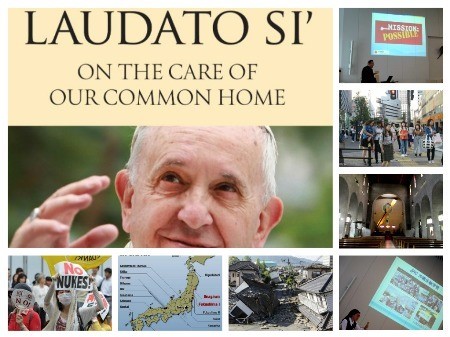
“LAUDATO SI” IN JAPAN CONTEXT
RESPONDING TO LAUDATO SI’: THE RELIGIOUS SUPERIORS’ ASSEMBLY IN JAPAN
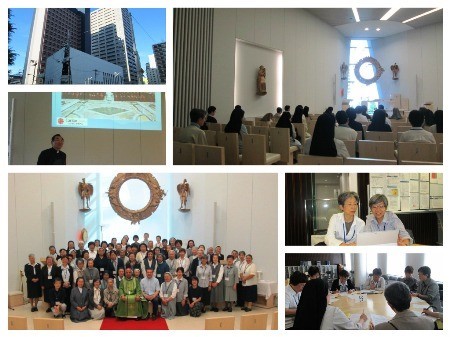
One year had already passed since the publication of Pope Francis’ encyclical Laudato Si’, yet its full Japanese translation had not been released because of the extensive work involved in translating the document. Nevertheless, this did not prevent the Association of Major Women Religious Superiors in Japan from choosing Laudato Si’ as the main theme of their General Assembly, held from June 1 to 4 at Sagrada Familia Parish in Osaka.
The Assembly brought together representatives from 65 religious congregations. It was also graced by the presence of the Apostolic Nuncio to Japan, Archbishop Joseph Chennoth, and the Bishop of Osaka, Bishop Manyo Maeda.
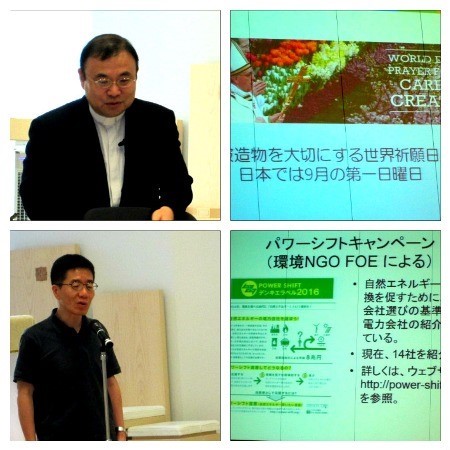
The first day featured a presentation by Fr. Hiro Kamatsu, a diocesan priest from Nagasaki, on “The General Contents of Laudato Si’.” On the second day, Professor Fumihiko Kubo of Sophia University, a Jesuit university, gave a clear and thought-provoking presentation entitled “Nuclear Radiation and the Christian Faith,” addressing one of the most sensitive and controversial issues facing Japan. On the third day, Bishop Isao Kikuchi shared his reflections on “Rethinking Evangelization.” These three conferences served as the basis for further study and reflection, from which various suggestions and concrete proposals emerged.
The participants were particularly moved by three important points highlighted in the encyclical:
- Everything that God has created is interconnected. This calls us to an understanding of integral ecology, recognizing the close relationship between humanity, creation, and the environment.
- Our planet is wounded by a “throwaway culture” and the globalization of indifference. We are challenged to examine our lifestyles and our attitudes toward people and creation.
- The use of nuclear energy raises serious questions concerning respect for life and the care of our common home.
In the light of these challenges, Pope Francis calls religious congregations to make a concrete commitment:
- To go beyond our “comfort zones”;
- To open our hearts and encounter, especially, those living on the peripheries;
- To ask ourselves continually what we want to leave for the next generations and to choose a new and more responsible way of living.
As a new task for the year, the Association of Major Superiors identified two priorities:
1. Support for the victims of the Kumamoto earthquake
Kumamoto, in southwestern Japan, was struck by a series of powerful earthquakes in April, with the strongest reaching magnitude 7.3. The earthquakes caused extensive damage to homes, buildings, roads, and mountain areas, resulting in hundreds of deaths and injuries. Many people were still without permanent shelter at the time of the Assembly. The Association therefore committed itself to extending support and solidarity to those affected.
2. Collaboration in the “Talitha Kum Japan” Project
The Association also committed itself to collaborating in the Talitha Kum Japan project, a joint initiative addressing situations affecting vulnerable persons, particularly women, migrants, and children of mixed Japanese heritage, among others.
The Hijas de Jesús is a very small congregation in Japan. Yet, despite our limitations, particularly those related to language, we continue to participate in these gatherings. Our presence is a simple way of being one with the Church in Japan and of sharing in its concerns as it responds to the challenges of the new evangelization.
We may be small in number, but we continue to offer whatever collaboration we can, trusting in the power of small and faithful gestures. We firmly believe that “It takes only a little yeast to make a whole batch of dough rise” (Gal 5:9).
By Sr. Flor FLorece, F.I.